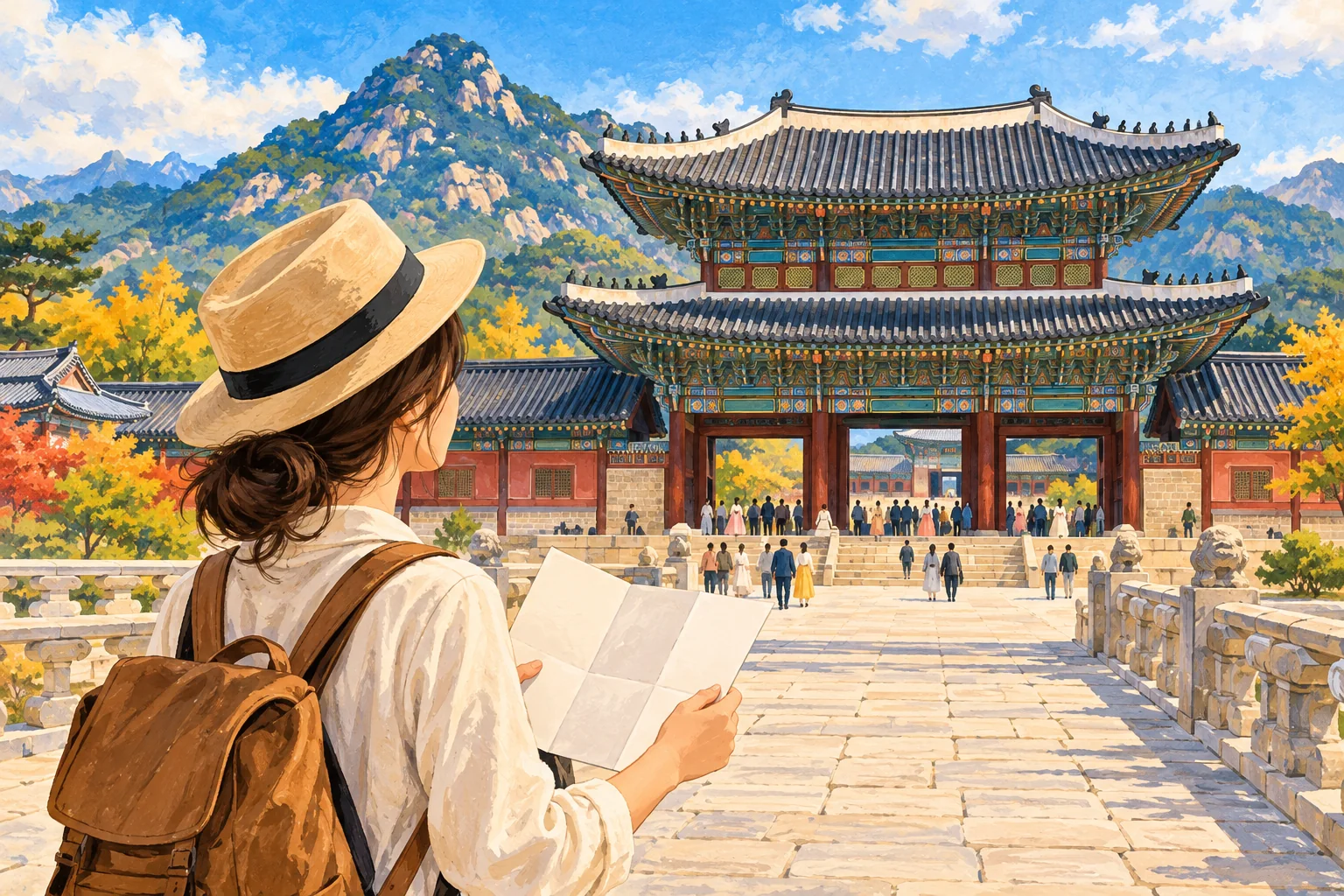
Gyeongbokgung normally closes on Tuesdays, and its daytime hours change with the season. Choose your date first, then check the last-entry time and any dated admission notice before planning your first palace visit.
What makes this palace distinct?
Gyeongbokgung was established in 1395 as the Joseon dynasty’s principal palace. Its present appearance reflects destruction, rebuilding and restoration: the palace burned during the 1592 invasion, was rebuilt in 1867 and later suffered colonial-period losses. Restoration has continued since the 1990s. Royal Palaces and Tombs Center: Gyeongbokgung history
That history gives a first visit a useful question: which spaces are you looking at, and what do their interpretation panels say about rebuilding? Do not assume every visible building has survived untouched since the fourteenth century.
Check the ordinary rules, then the dated notice
Gyeongbokgung normally closes on Tuesdays. If Tuesday is a public or substitute holiday, closure moves to the first following non-holiday. Standard admission for foreign visitors ages 19–64 is KRW 3,000. Visit Seoul: Gyeongbokgung visitor information
| Months | Open | Last entry |
|---|---|---|
| January–February; November–December | 9 a.m.–5 p.m. | 4 p.m. |
| March–May; September–October | 9 a.m.–6 p.m. | 5 p.m. |
| June–August | 9 a.m.–6:30 p.m. | 5:30 p.m. |
For transit planning, the city lists Gyeongbokgung Station (Line 3), Exit 5, and Gwanghwamun Station (Line 5), Exit 2. Check your route and the palace entry point before leaving; the exits are not interchangeable meeting points.
A manageable first-visit approach
- Give the palace its own appointment. Put the closing time and last-admission time in separate calendar fields. Arriving just before ticket sales end leaves little time to understand the site.
- Start with the visitor map and interpretation. Choose a small number of areas you want to understand rather than trying to photograph every building.
- Read before comparing. Record one architectural detail and one historical change. This creates a more useful memory than treating a restored palace as a costume backdrop.
- Keep the next activity flexible. A guide, a queue or a closed section can change your pace. This is an editorial planning method, not a timed route tested on site.
What this daytime plan does not include
Do not treat a normal daytime ticket as permission for a special evening event. Check the specific event’s dates, entry rules and booking channel separately. Likewise, a nearby museum or another palace may have its own closure and admission rules.
If a particular ceremony, interior or accessible route is essential, confirm it with the palace for your date before committing to transport or a rental. This guide does not guarantee those experiences.
QUESTIONS & EXPERIENCES
Comments 0
Share a question or experience about this guide, then keep the conversation going with replies.
No published comments yet. Be the first to share a question or experience.