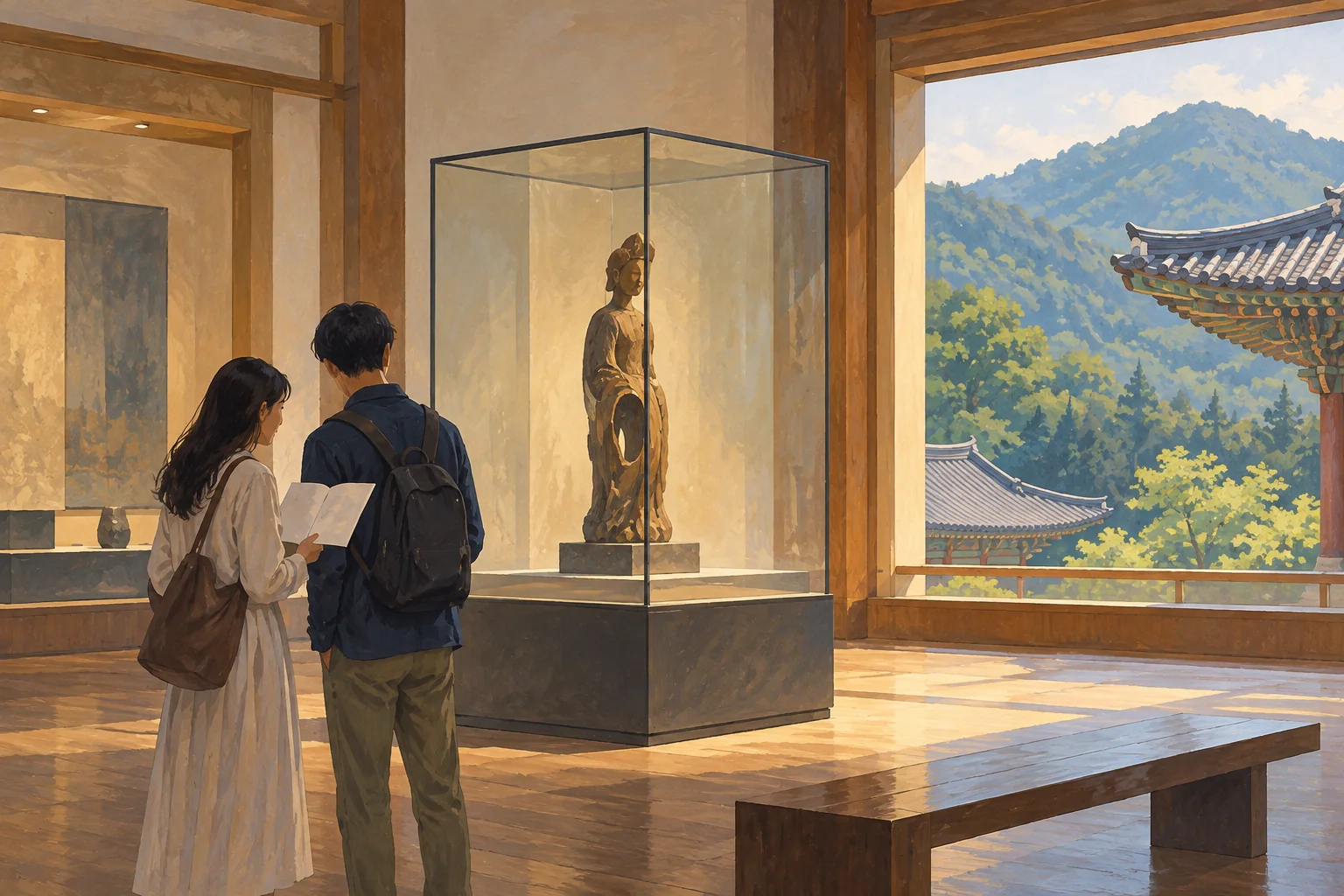
Haeinsa Museum’s special exhibition runs through January 3, 2027, but that does not mean every original object stays on display for the full run. Its official rotation notice lists the original seated statue of Master Huirang (희랑대사) only through October 21, 2026, followed by a reproduction. If that object is the reason for your trip, check the rotation notice—not just the exhibition’s closing date.
What is on, and why the dates matter
The special exhibition, whose Korean title is 해인사, 신라에 뿌리내려 고려에 꽃피우다, explores Haeinsa’s development from its Silla-period beginnings through the Goryeo period. The museum lists September 22, 2026–January 3, 2027 for the exhibition as a whole. It also warns that some objects rotate for conservation and safety.
The separate September 22 rotation notice is more specific. As of this guide’s October 27 check, the listed original-statue display period had already ended. That is a schedule-based statement, not an eyewitness confirmation of the current case. Read the label when you arrive and ask museum staff if seeing an original is essential to your visit.
Museum hours and admission
- Open: Tuesday–Sunday, 10 a.m.–5 p.m.
- Last admission: 4:30 p.m.
- Regular closure: Monday.
- Museum admission: free; Haeinsa parking charges are separate.
- Address: 1742-17 Gayasan-ro, Gaya-myeon, Hapcheon-gun, Gyeongsangnam-do.
These are the museum’s own published details, checked October 27, 2026. All times are Korea Standard Time. They are not the hours or admission rules for every part of the temple complex. Check the museum’s notices for an exceptional closure before traveling.
A museum visit is not a woodblock-depository booking
UNESCO’s Haeinsa inscription concerns the Janggyeong Panjeon depository buildings, which house the Tripitaka Koreana woodblocks. That is a different visitor question from which objects are displayed in a museum gallery. Museum admission does not establish permission to enter a protected depository interior.
This guide does not confirm current interior-tour availability, booking eligibility, or temple-area charges. If entering the depository is essential, obtain current confirmation directly from the temple before arranging travel around it. Do not use the museum’s free-admission line as a substitute.
Build a visit around a question, not one photograph
The museum’s 2026 permanent-display announcement separates a history-and-Buddhist-painting room from a Buddhist-sculpture-and-craft room. You could compare how a painted image and a sculpted figure tell a religious story, then read the labels for the material, date, and purpose of each object.
- Save both the exhibition page and the rotation notice.
- Identify whether your must-see object is an original, a reproduction, or no longer listed for your date.
- Check opening notices and plan your return transport separately.
- Follow gallery photography instructions; do not assume the permission is the same throughout a religious site.
No exhibition visit or interior tour was personally tested for this guide.
Official sources
Checked October 27, 2026.
QUESTIONS & EXPERIENCES
Comments 0
Share a question or experience about this guide, then keep the conversation going with replies.
No published comments yet. Be the first to share a question or experience.