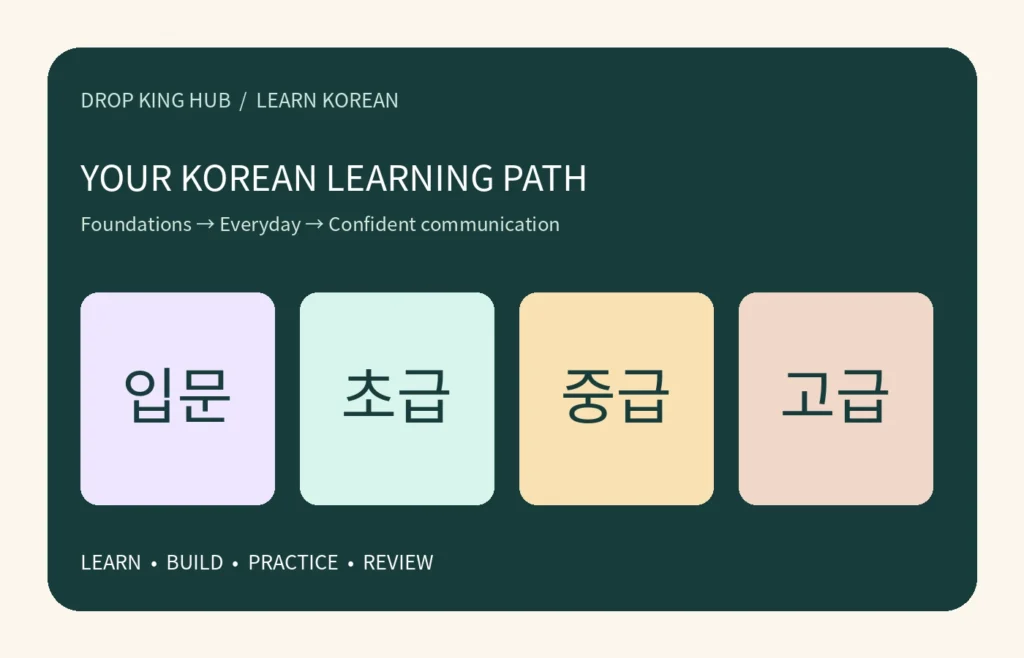
DROP KING HUB · LEARN KOREAN
한글
Small blocks.
A new way to read.
See the pattern. Build a syllable. Try it yourself.
Lessons 1–6 open · 24 basic letters in Lesson 1
Start with Hangul. Build sentences. Use Korean in real situations.
Hangul is the writing system; Korean is the language. Recognizing every letter is a foundation, not the end of learning Korean. Follow the core levels below, then add a practical path that matches your goal.
Our levels are learning routes, not qualifications. They are not TOPIK scores, CEFR certifications, or King Sejong Institute course credits. A visual self-check cannot measure listening, speaking, or overall proficiency. Audio and live conversation need separate practice.
See your first four steps
Start at 1. Each step adds just one new idea.
- ㄱ + ㅏ → 가1 · Build a block
Basic letters. Right-side and lower vowels.
- 가 → 까2 · Change the starting letter
Five tense consonants, one position each.
- ㅇ + ㅘ → 와3 · Make room for a bigger vowel
Eleven more vowel letters. Still one block.
- 사 + ㄴ → 산4 · Add a final underneath
Find batchim and build a three-letter block.
After the foundation: read useful words, make your first polite introduction, then build daily-life sentences. Future lessons will be linked only when published.
What is open now?
Open now: Lessons 1–6. Choose a lesson below.
In preparation: lessons after Lesson 6 and the wider level-based course. The first Beginner introduction is open; the rest of Beginner, Intermediate, Advanced and purpose-focused routes remain in preparation. A route shown below is a curriculum plan, not a completed course.
Your numbered lesson sequence
Start with Lesson 1. Later lessons reuse earlier letters before adding something new. The number of lessons in the full Korean program is not fixed: only the lessons listed as open are available.
Meet the basic letters
Explore 14 basic consonants and 10 basic vowels, then build and practice in small steps.
Open Lesson 1Five tense consonants
Compare familiar letters with ㄲ ㄸ ㅃ ㅆ ㅉ, then build and check.
Open Lesson 2Eleven additional vowels
Small sessions for right-side and combined layouts. Reuse the consonants.
Open Lesson 3First final consonants
See the final position, read simple words, and distinguish letters from their pronunciation.
Open Lesson 4Read picture words
Match 나무 and 우유 to pictures, then rebuild each word.
Open Lesson 5Your first polite introduction
Say hello and choose 이에요 or 예요 after a name.
Open Lesson 6Foundation · Read and build Hangul
Start here if: Korean letters are new, or you still depend on Romanization.
You will work toward: recognizing all 19 consonant and 21 vowel letters; placing letters into syllable blocks; reading simple examples; recognizing the final-consonant position; copying legible shapes.
Learning route: basic consonants → basic vowels → tense consonants → additional vowels → block layouts → first final consonants → mixed reading and writing review.
Before moving on: try a new combination rather than reciting a memorized chart. Separate its initial, vowel, and optional final consonant. Copy it, then hide the model and rebuild it. Revisit any shape you confuse.
Scope: this is modern Hangul literacy practice, not a promise that you can pronounce every word from spelling alone.
Beginner · Build everyday sentences
Start here if: you can slowly read Hangul blocks and recognize a final consonant.
You will work toward: introducing yourself; identifying things and places; asking simple questions; expressing present, past, and intended actions; making a polite request; reading short practical messages.
Learning route: introductions → noun sentences → topic and subject → location and existence → basic verbs and polite endings → numbers, time, and counters → past events and plans → daily-life task review.
Readiness task: write a short introduction and a request for a familiar situation. Can another reader identify who you are, what you need, and when? Compare with feedback, revise, and try a new situation. A model answer is one possible answer, not the only correct wording.
Intermediate · Connect ideas and manage situations
Start here if: you can make short connected sentences about familiar needs without copying every line.
You will work toward: explaining a reason; comparing options; describing a sequence; reporting what someone said; clarifying a misunderstanding; adjusting requests for the relationship and setting.
Learning route: reasons and sequence → comparison and choice → experiences and intentions → reported information → connected reading and short writing → social and workplace scenarios.
Readiness task: explain a problem, propose an option, and give a reason in a connected message. Then rewrite the same request for a friend and for someone you have just met. Check meaning, organization, and register—not just grammar endings.
Advanced · Interpret, evaluate, and adapt
Start here if: you can explain familiar issues in connected Korean and follow a longer written argument with support.
You will work toward: distinguishing a writer’s claim from evidence; summarizing without copying; qualifying disagreement; presenting a structured argument; adapting a text for audience, purpose, and register.
Learning route: text structure → stance and nuance → evidence and qualification → synthesis and summaries → presentations and professional writing → revision workshop.
Readiness task: read a short source, summarize its main point, identify one limitation, and write a reasoned response. Keep the source’s position separate from your own. Ask a proficient human for feedback on nuanced or high-stakes communication.
These paths connect to the core levels; they are not extra proficiency grades. You can use more than one path.
Everyday Korean
Entry: Beginner, after noun sentences and basic polite requests.
Route: ordering and shopping → transport and appointments → home and daily routines → explaining a problem → handling an unexpected change.
Practice product: a short exchange or message with a clear purpose. Later tasks add follow-up questions and repair strategies.
Business Korean
Entry: Beginner for introductions and basic schedules; Intermediate for connected requests and email; Advanced for nuanced proposals and discussion.
Route: introduce your role → confirm time and tasks → request information politely → explain a delay → summarize decisions → compare proposals and respond diplomatically.
Practice product: an original workplace message with a clear action, responsible person, and relevant date. Examples are fictional. Language practice is not legal, contractual, or professional advice.
Honorifics and speech levels
Entry: starts in Beginner; revisited at every level.
Route: polite listener-facing endings → respectful address and titles → honoring the person being discussed → respectful and humble vocabulary → choosing a consistent register for a whole interaction.
Practice product: choose wording for a stated relationship and setting, explain the choice, and compare alternatives. Respect is not simply adding 요 to every sentence. Avoid guessing familiarity; follow the other person’s stated preference and the situation.
Applied Korean · Put the pieces together
Entry: choose the task matching your core level.
Beginner task: read a short menu and draft a polite order.
Intermediate task: read a fictional appointment change and write a clarification request.
Advanced task: compare two fictional proposals and write a reasoned recommendation.
Practice product: one complete task, followed by revision. Do not use private documents or personal details in exercises.
- Know the goal. See the prerequisite and one achievable task.
- Notice the model. Read a short example with a diagram or explanation when useful.
- Try with support. Change one meaningful part; do not just copy.
- Try independently. Hide the example and complete a new prompt.
- Check and explain. Reveal an answer, the reason, and a common error. Open-ended tasks show sample responses and a checklist rather than pretending there is one automatic score.
- Return and reuse. Revisit later, then apply the pattern in a different situation.
Choose a lower level if the prerequisite feels uncertain. You may move between levels; finishing a page does not certify mastery. Unless a lesson explicitly says otherwise, self-check answers and progress are not saved.
The overall distinction between introductory study, general proficiency levels, and purpose-focused study is informed by the Online King Sejong Institute curriculum. The progression from familiar everyday communication toward extended and specialized communication is also informed by the Korea University Korean Language Center curriculum. Our routes, tasks, explanations, and level checks are independently designed; neither institution endorses this site. Sources checked October 29, 2026.
QUESTIONS & EXPERIENCES
Comments 0
Share a question or experience about this guide, then keep the conversation going with replies.
No published comments yet. Be the first to share a question or experience.