You cannot board at Incheon Airport Terminal 1 or Terminal 2 with Seoul’s short-term Climate Card. You can exit at either terminal with a valid pass after boarding within the covered area. Treat your arrival journey and your return to the airport as two separate decisions.
This guide covers the 1-, 2-, 3-, 5-, and 7-day passes under the coverage effective October 1, 2026, not the former 30-day prepaid pass. Seoul says 30-day recharges ended August 31, 2026; existing cards can still load short passes.
Landing at Incheon? Plan another ticket
For the trip into Seoul, choose the service first. The AREX All-stop Train accepts a standard transport card such as Tmoney. The Express Train is a different, reserved-seat service. Do not confuse a stored-value Tmoney card with a time-based Climate Card pass.
Before approaching the gate, check the destination and train type on the machine or ask station staff. A card branded for Seoul travel is not proof that it covers your airport departure station.
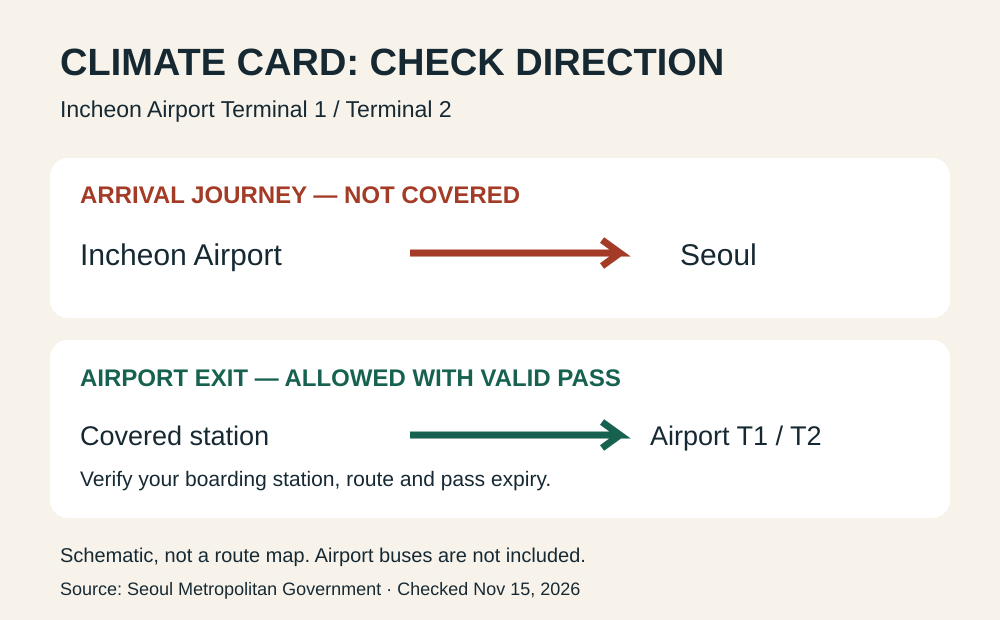
Returning to the airport
Use the AREX All-stop route; do not treat this as a reserved-seat Express ticket. Check three things: your boarding station is covered, your pass remains valid, and your destination is Terminal 1 or Terminal 2. Seoul’s airport exception does not make every station outside Seoul eligible. Gimpo Airport Station is included because it is within Seoul. Airport and express buses, GTX and the Sinbundang Line are not covered.
Use the official station table linked below to check the exact line and direction. If a gate rejects the card, ask station staff rather than assuming the journey is included.
When should you load the pass?
The short pass starts on its recharge date, not on a later date you choose. It lasts through the final service on its expiry date, not a rolling 24-hour period from purchase. Match the loading day to your itinerary.
The physical card costs KRW 3,000 separately. Pass prices are KRW 5,000 for one day, 8,000 for two, 10,000 for three, 15,000 for five, and 20,000 for seven. These are Korean-won prices, not U.S.-dollar estimates.
Can you use a U.S.-issued payment card?
Seoul’s March 17, 2026 announcement covers overseas Visa and Mastercard payments at designated new vending machines on Lines 1–8 for Climate Card purchases and short-pass reloads. It reports an average fee of about 3.7%. That is not a promise that every machine accepts your card, or that a regular Tmoney reload works the same way.
Check the machine’s accepted payment methods and final fee before paying. Keep a workable alternative if your card is declined. We reviewed official guidance; we did not test a purchase or ride.
Official sources
Sources checked November 15, 2026; coverage reconfirmed November 16, 2026. Recheck before travel because coverage and payment options can change.
QUESTIONS & EXPERIENCES
Comments 0
Share a question or experience about this guide, then keep the conversation going with replies.
No published comments yet. Be the first to share a question or experience.