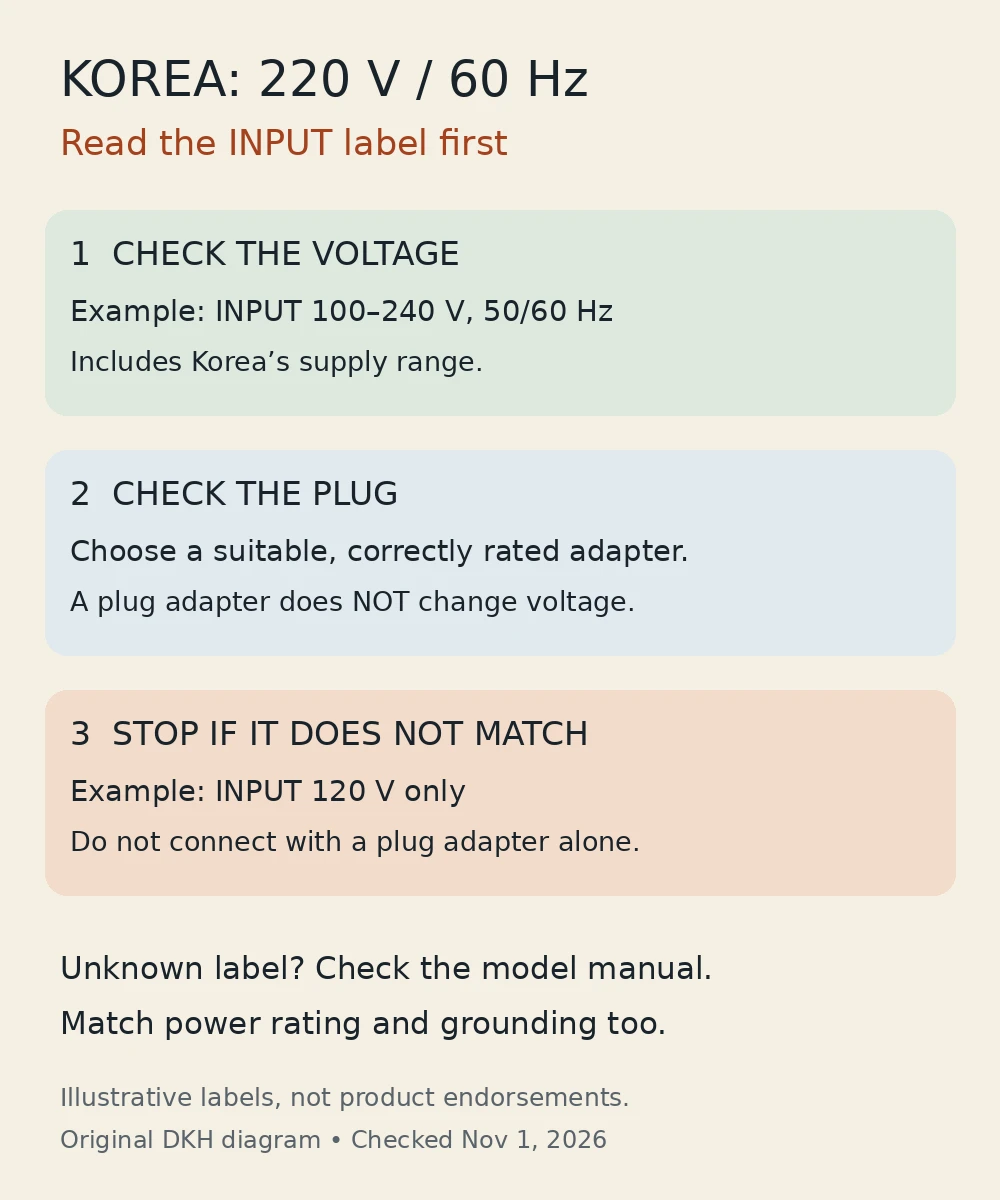
A U.S. charger does not automatically need a voltage converter in Korea. First check its INPUT rating: if it accepts 220 V at 60 Hz, you need an appropriate plug adapter only when the plug does not fit. A plug adapter alone cannot make a 120 V-only appliance safe on a 220 V supply.
This guide is for travelers packing U.S.-purchased electronics for South Korea. International readers can use the same label check; the device’s actual specifications matter more than where it was purchased.
What outlets and voltage does Korea use?
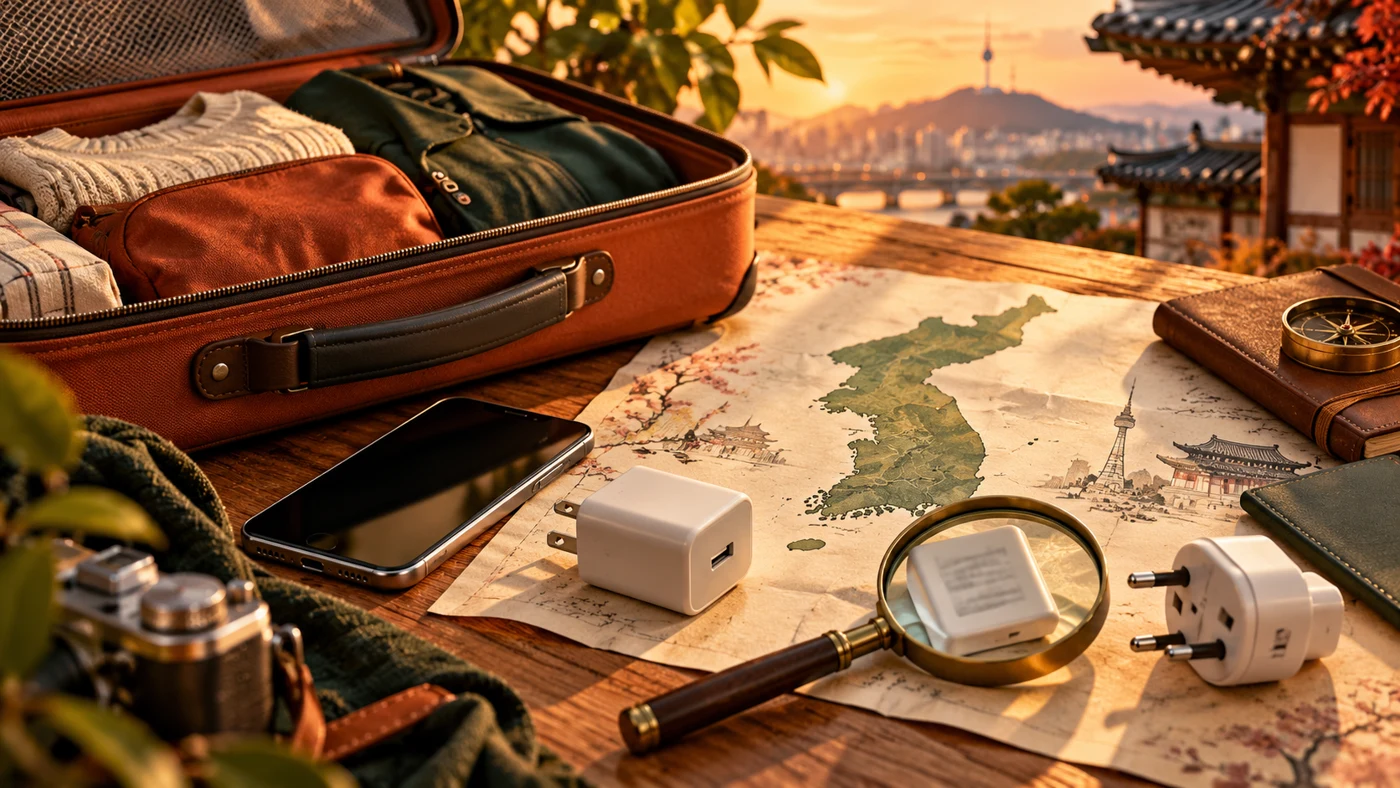
The Korea Tourism Organization lists Korea’s standard electricity supply as 220 V, 60 Hz, with two round holes in the outlet. Seoul Tourism Organization identifies the commonly used plug types as C and F. That differs from the flat-blade plugs familiar to U.S. travelers. Physical fit and electrical compatibility are separate questions.
Read INPUT, not just the USB output
Look at the label on the charger or appliance that connects to the wall. A phone charger’s USB output specification is not its mains-input rating. If the label is unclear, find the exact model’s manufacturer instructions before connecting it.
- Example: INPUT 100–240 V, 50/60 Hz. This range includes Korea’s 220 V, 60 Hz supply. Voltage conversion is not needed for that input specification; the plug, adapter rating and any grounding requirements still need to match.
- Example: INPUT 120 V only. Do not plug it into Korea’s standard supply using only a passive travel adapter. Check the manufacturer’s approved travel arrangements or use an appropriate local appliance instead.
- Missing or unreadable rating. Treat compatibility as unconfirmed. A familiar brand, USB-C connector or “travel” label is not a substitute for the model specification.
These labels are illustrative examples, not specifications for the pictured objects. Apple provides a concrete manufacturer example: its USB power-adapter support page specifies 100–240 V AC at 50–60 Hz. That does not establish the rating of every charger, accessory or appliance in your bag.
Before you pack
Check each device separately and follow its manufacturer’s instructions. Match the adapter’s permitted power/current and grounding to the appliance; never defeat an earth connection. For a hair dryer or styling tool, verify its own voltage setting and rating rather than borrowing the conclusion from your phone charger.
If compatibility is unconfirmed, ask the manufacturer or arrange a compatible appliance at your accommodation. VISITKOREA lists hotels and shops as possible adapter sources, but availability is not guaranteed.
Official sources
Checked November 1, 2026. This is a document-based packing guide, not a physical test of chargers, outlets or hotel equipment.
- Korea Tourism Organization: electricity and communications — Korean supply, outlet shape and adapter availability.
- Seoul Tourism Organization: travel information — independent official confirmation of 220 V/60 Hz and Type C/F plugs.
- Apple: USB power adapters — the manufacturer’s stated input-voltage range for its USB adapters.
- Brennenstuhl: choosing a travel adapter — physical adaptation versus voltage conversion. This is manufacturer guidance, not an independent product comparison.
Continue planning with our Korea travel guides.
QUESTIONS & EXPERIENCES
Comments 0
Share a question or experience about this guide, then keep the conversation going with replies.
No published comments yet. Be the first to share a question or experience.