Korea Standard Time (KST) stays at UTC+9 all year, but the local U.S. time of a Korean announcement can change when daylight saving time ends. For a K-pop livestream, release or ticket deadline, convert the announcement’s full date and time—not just “8 p.m. KST”—using Seoul and your own city.
In U.S. locations that observe daylight saving time, clocks move back on November 1, 2026, at 2 a.m. local time. That does not mean the Korean event has moved. It means the difference between the two clocks has changed.

What 8 p.m. KST means before and after the clock change
These are worked examples, not announcements of actual events. New York and Los Angeles are examples, not a single time zone for the entire United States.
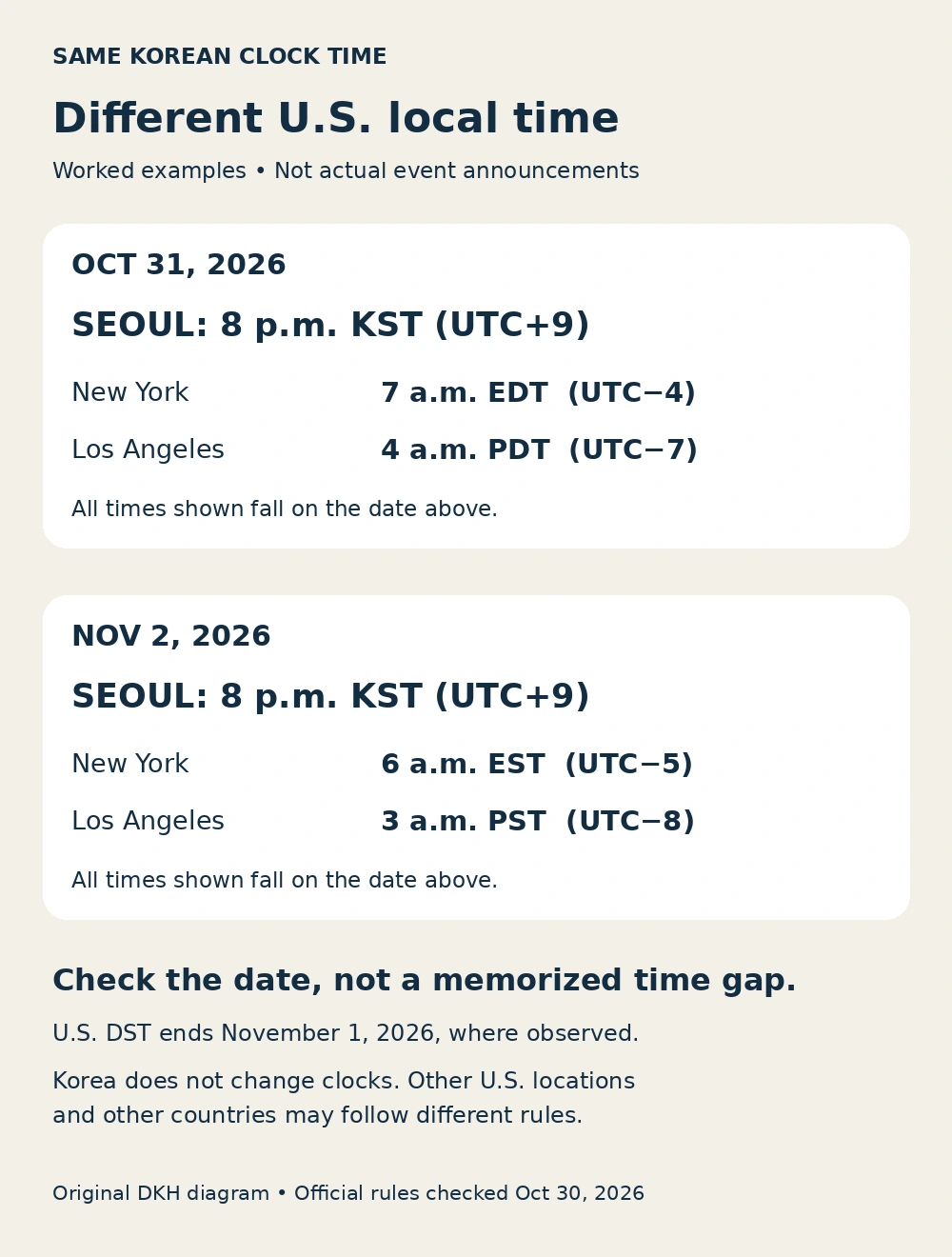
- October 31, 2026, 8 p.m. in Seoul: October 31 at 7 a.m. in New York (EDT, UTC−4), or 4 a.m. in Los Angeles (PDT, UTC−7).
- November 2, 2026, 8 p.m. in Seoul: November 2 at 6 a.m. in New York (EST, UTC−5), or 3 a.m. in Los Angeles (PST, UTC−8).
The same Korean clock time is one hour earlier on those U.S. clocks after the change. Do not reuse an old conversion without checking its date.
Save a Korean schedule without guessing the time difference
- Read the original notice. Copy the year, month, day, clock time and stated time zone. Distinguish a ticket-sale deadline, venue entry time and performance start; they are different events.
- Enter the original time in the event’s time zone. In Google Calendar on a computer, choose Create → Create event → More options. Beside the event time, select Time zone, search for Seoul, and select its time zone, then click OK. Enter the Korean date and time before saving. Use a timed event rather than an all-day reminder.
- Check the local date as well as the hour. Calendar displays the event in your local time zone. Make sure that zone is your intended location, especially when traveling. A midnight Korean release can fall on the previous U.S. date.
- Keep the official notice link with the reminder. Before buying or joining, reopen the latest organizer or artist notice. A saved calendar entry does not automatically prove that an organizer has kept the same schedule.
Midnight in Korea may still be yesterday for you
For example, November 3, 2026, at 12:00 a.m. KST is November 2 at 10 a.m. in New York (EST) and November 2 at 7 a.m. in Los Angeles (PST). This is another conversion example, not a release announcement. “12 a.m.” means midnight; “12 p.m.” means noon.
Exceptions worth checking
- Not every U.S. location changes clocks. Hawaii and most of Arizona do not observe daylight saving time; the Navajo Reservation in Arizona does. Puerto Rico, Guam, American Samoa and the U.S. Virgin Islands also do not observe it. Use the actual destination city or local zone rather than assuming “U.S. time.”
- EDT and EST are not interchangeable. In these examples they differ by one hour. If an announcement’s date, city and abbreviation conflict, ask the organizer which time is intended rather than silently correcting it.
- The repeated hour needs a clear zone. When clocks fall back, a local time between 1 a.m. and 2 a.m. can occur twice. A complete KST date and time identifies the moment; an unqualified U.S. “1:30 a.m.” may not. Keep the offset or daylight/standard label with that conversion.
- Other countries follow their own rules. Do not apply the U.S. November 1 date to the UK, Europe or every global reader. Calendar software also warns that distant dates or changed time-zone rules may be displayed incorrectly; recheck the official schedule close to the event.
Official sources and what we checked
Checked October 31, 2026. The conversions above are calculated examples, not reported attendance or a test of an event booking.
- Seoul Tourism Organization: travel information — Korea’s UTC+9 time zone and no daylight saving time.
- NIST: daylight saving time — the 2026 U.S. change date, local clock change and exceptions.
- U.S. Naval Observatory: 2026 daylight saving time — an independent official check of the November 1 end date.
- Google Calendar Help: different time zones — event-specific zones, local display and limitations.
Checking a presale as well? Read our K-pop fan-club presale guide for the separate question of membership, registration and ticket eligibility.
QUESTIONS & EXPERIENCES
Comments 0
Share a question or experience about this guide, then keep the conversation going with replies.
No published comments yet. Be the first to share a question or experience.