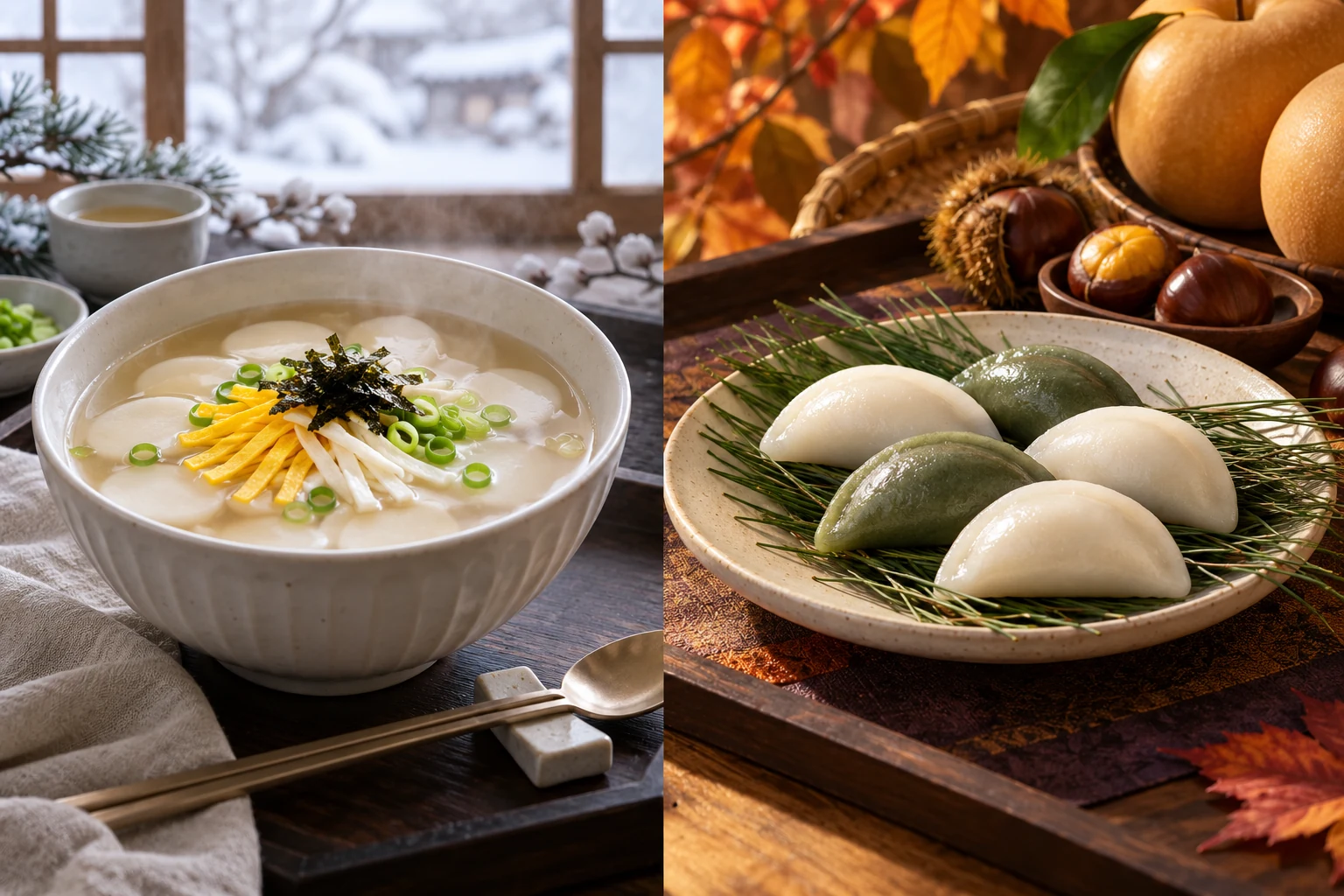
Seollal welcomes the lunar new year; Chuseok is associated with the autumn harvest. Both can bring family gatherings, but they are not interchangeable versions of the same holiday.
The basic distinction
Korea Tourism Organization describes Seollal on the first day of the first lunar month, with customs including greetings to elders and tteokguk. Chuseok falls on the fifteenth day of the eighth lunar month and is associated with harvest foods such as songpyeon. Their Gregorian dates change from year to year.
A label is not the whole tradition
“Korean Thanksgiving” can be a helpful first comparison for Chuseok, but it does not make the holiday equivalent to the American one. Likewise, a description of ancestral rites should not be read as a claim that every household follows an identical religious or family practice.
If you are invited
Ask your host what to expect, whether you should bring anything, and how you can participate respectfully. Mention dietary restrictions in advance. A short cultural guide cannot substitute for that conversation, and there is no need to pretend you already know the household’s customs.
If you are traveling
Confirm dates for your actual travel year and check transport bookings, attraction hours, and any special admission notice directly. Do not assume every museum is open or every palace is free because a past holiday article described such an offer. For a useful comparison, write “meaning,” “food,” and “travel checks” on separate lines rather than collecting a list of supposedly universal rules.
Official sources
Sources checked October 27, 2026 (KST).
QUESTIONS & EXPERIENCES
Comments 0
Share a question or experience about this guide, then keep the conversation going with replies.
No published comments yet. Be the first to share a question or experience.