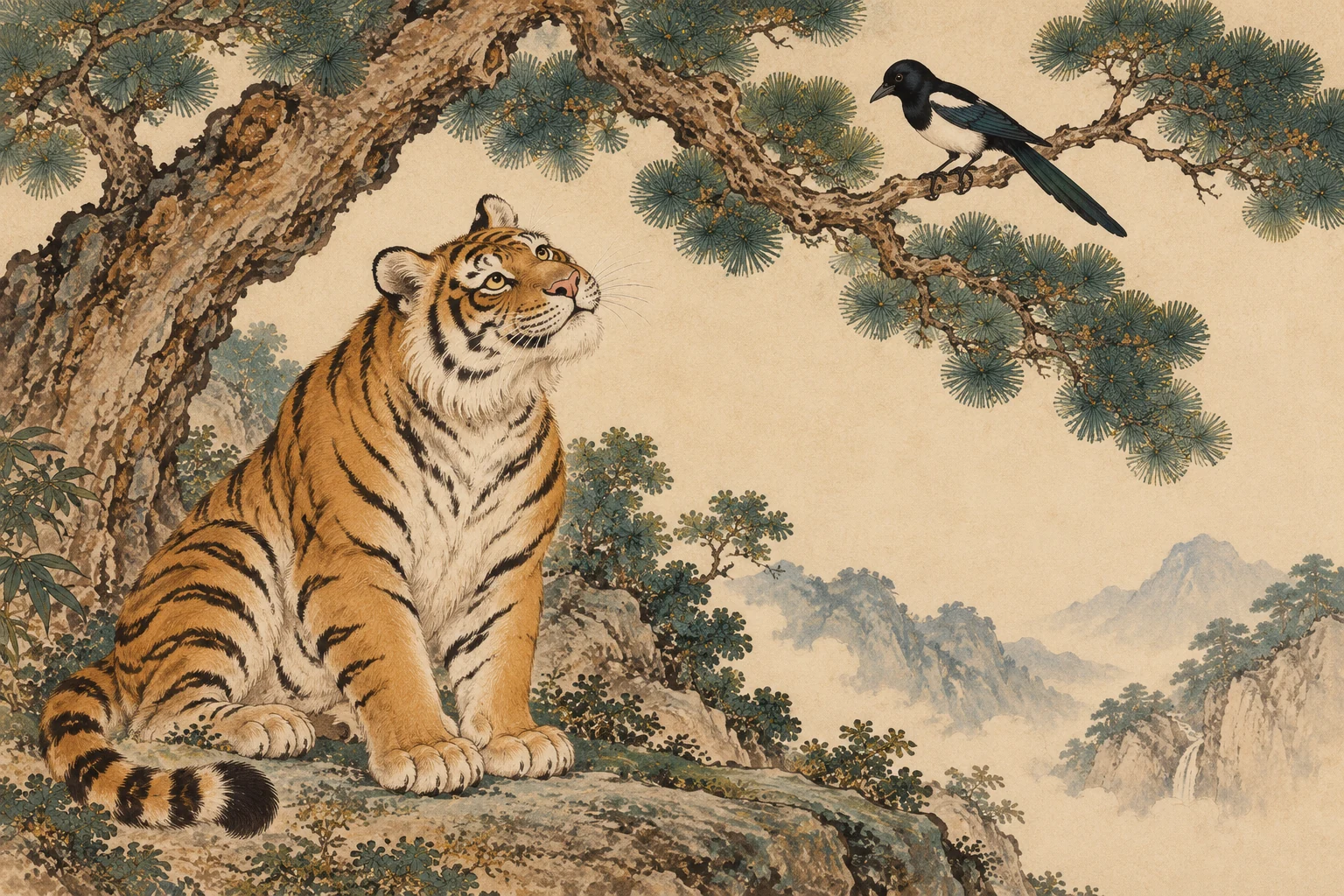
A tiger and a magpie are more than an unlikely animal pair in Korean folk painting. Their relationship can combine protection, humor, and a playful reversal of power. Read the whole scene, rather than treating either animal as a symbol with one fixed meaning.
Start with the relationship
The National Research Institute of Cultural Heritage describes a tiger looking toward a magpie in a pine tree as a familiar folk-painting subject. Tigers could represent protection against harmful forces. In this pairing, however, a tiger may look comically foolish while the much smaller bird seems to lecture it. The contrast has been interpreted as satire involving rulers and ordinary people.
A three-question way to look
First, compare scale: which creature is physically powerful? Next, look at posture and expression: which seems confident? Finally, follow their lines of sight. These questions are a viewing exercise, not a promise that every painting has an identical message. Compare your observations with the museum label for the specific work.
Keep the artwork separate from its modern remix
An animation, a souvenir, and a historical painting are different objects. Recognizing a shared motif does not establish that a particular movie character reproduces one named painting. Before sharing an image, check the individual image license; a museum page being public does not make its photograph free to reuse.
Try this next
When you find another tiger painting, note whether a magpie is present at all. Describe what you can actually see before assigning a meaning. That small habit makes cultural references easier to understand without reducing Korean art to a list of symbols.
Official sources
Sources checked October 27, 2026 (KST).
QUESTIONS & EXPERIENCES
Comments 0
Share a question or experience about this guide, then keep the conversation going with replies.
No published comments yet. Be the first to share a question or experience.