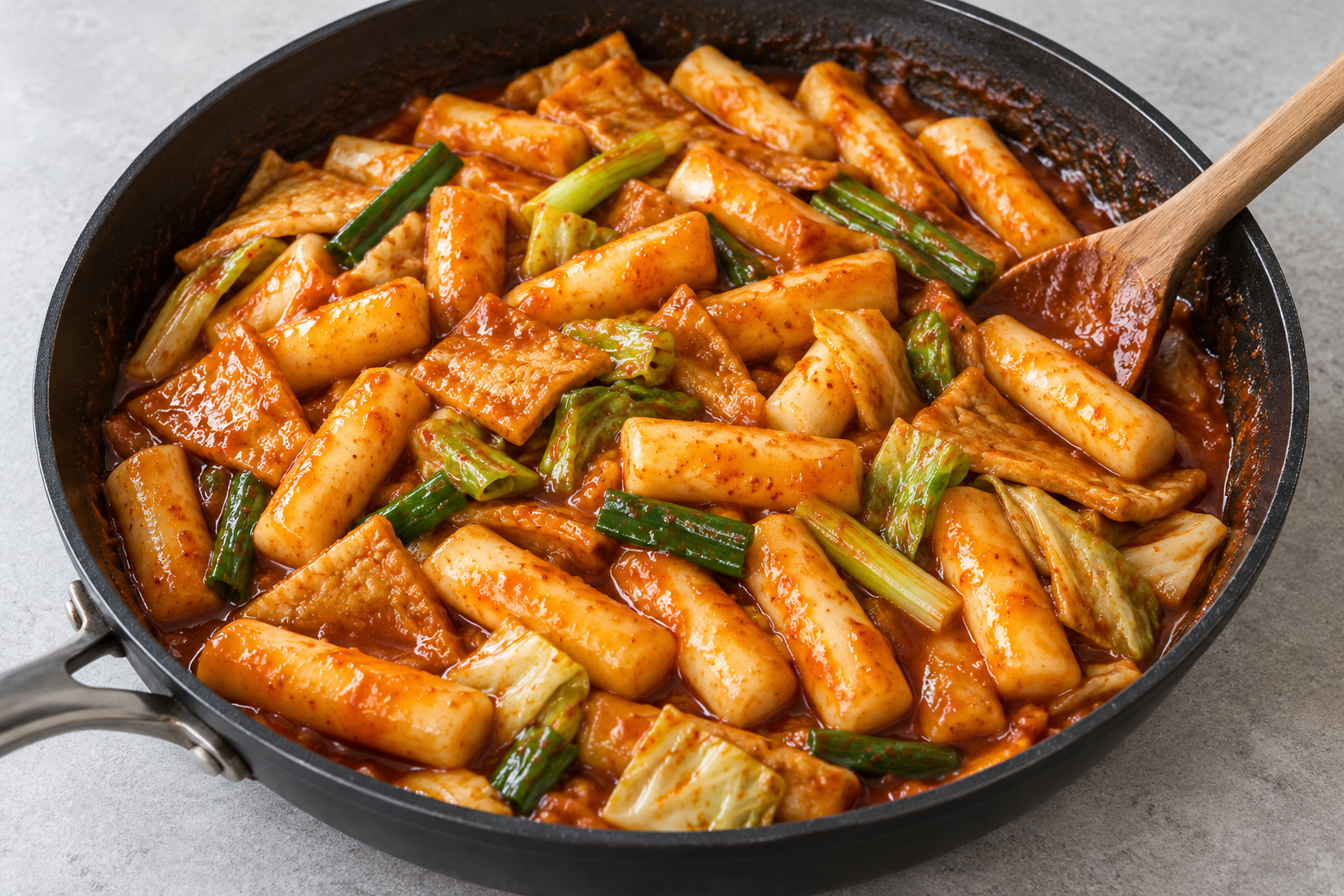
Simmer Korean rice cakes in a gochujang sauce, then add fish cakes, cabbage and scallions. Tteokbokki (떡볶이) should be chewy and tender, with sauce that coats the rice cakes. This is an independently written, source-informed adaptation; we have not cooked or taste-tested it.
Before you start
Yield: 3 snack portions. Equipment: wide, deep-sided pan and wooden or silicone spoon. Use plain rice cakes sold for tteokbokki, not a complete kit with its own sauce. Fresh, refrigerated and frozen products behave differently; check thawing, soaking and cooking instructions before starting. There is no verified total time for this adaptation.
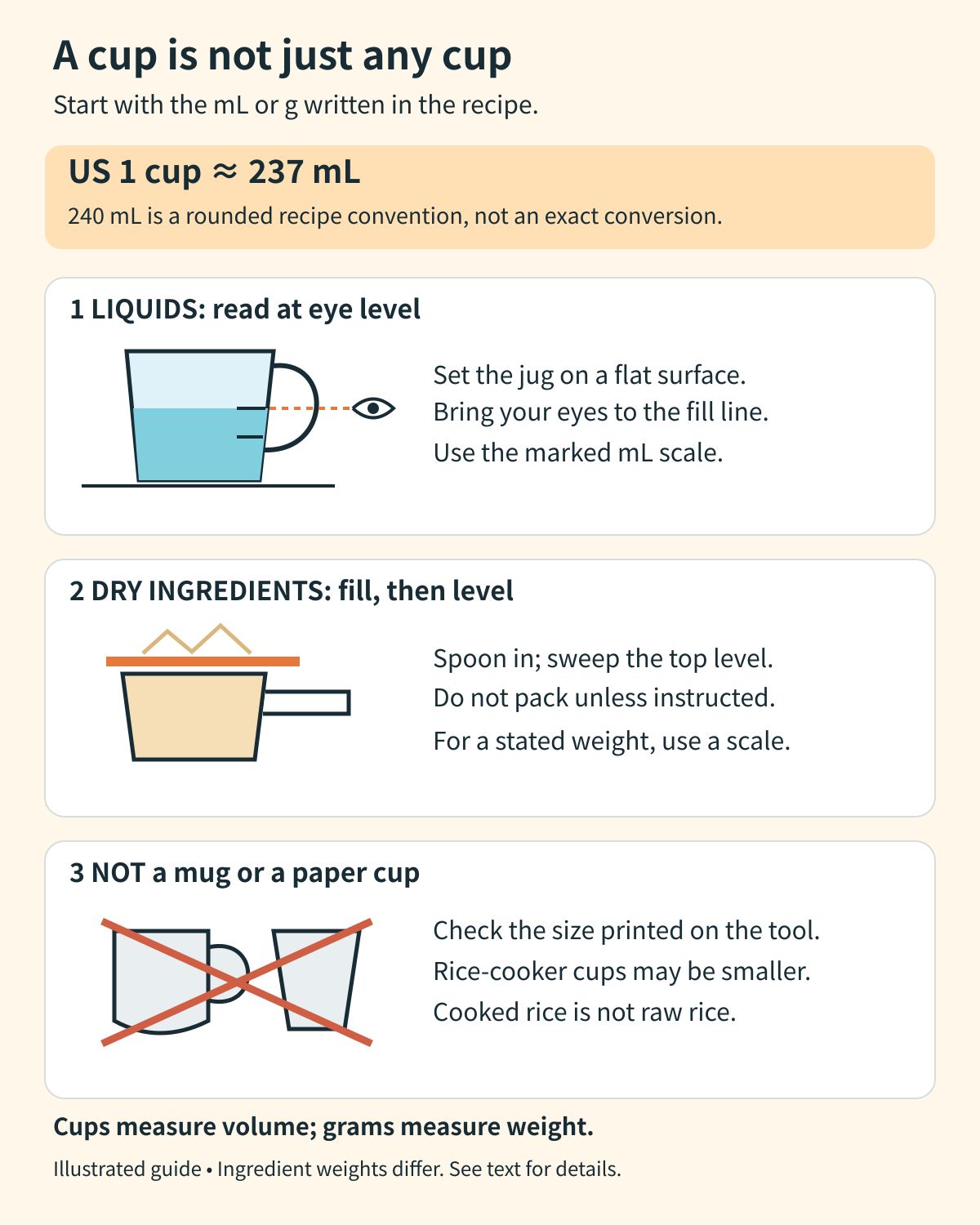
Metric weights are rounded. Spoon measures are volumes: 1 tablespoon ≈ 15 mL, 1 teaspoon ≈ 5 mL; 1 US cup is rounded to 240 mL here.
Which measuring cup?
Use the stated mL or g when supplied. See our visual measuring guide and unit notes.
Ingredients
- 1 lb (454 g) plain cylindrical tteokbokki rice cakes
- 5.3 oz (150 g) Korean fish-cake sheets, cut into bite-size pieces
- 4 oz (113 g) green cabbage, cut into squares
- 2 scallions, cut into 2-inch (5 cm) lengths
- 3 cups (720 mL) prepared unsalted anchovy-kelp broth, or water, plus extra as needed
- 3 tablespoons (45 mL) gochujang
- 1 teaspoon (5 mL) gochugaru; omit for less heat
- 1 tablespoon (15 mL) soy sauce
- 2 tablespoons (30 mL) granulated sugar
- 1 tablespoon (15 mL) light corn syrup
- 1 tablespoon (15 mL) minced garlic
Method
- Prepare the rice cakes. Follow your package for thawing and soaking. Fresh, already-soft cakes may need no soaking; firm refrigerated cakes often do. Do not apply one fixed soaking time to every brand. Separate and drain the cakes before cooking.
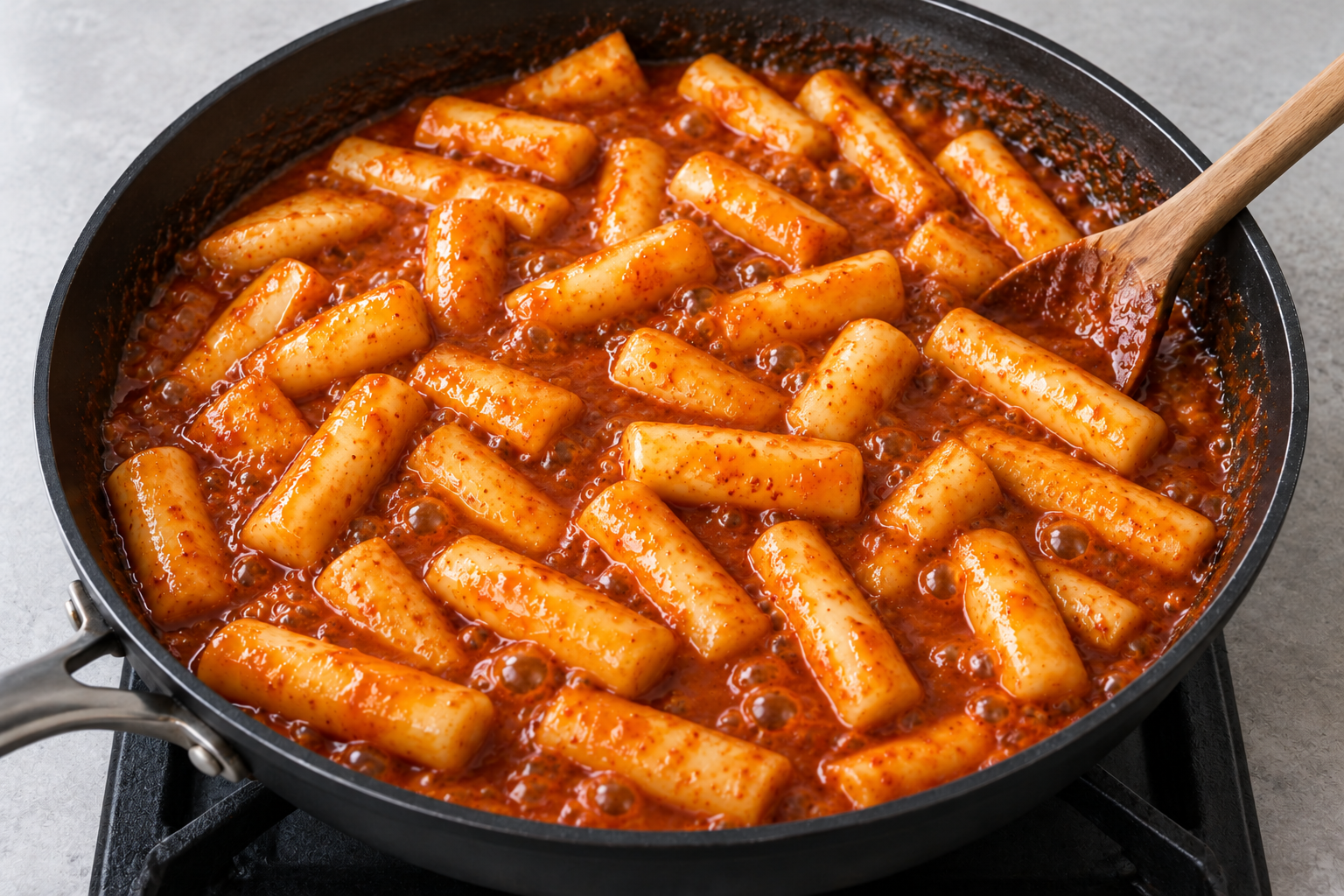
- Dissolve the seasonings. Put the broth, gochujang, gochugaru, soy sauce, sugar and corn syrup in the pan. Heat, stirring, until the paste disperses and the liquid begins to boil.

- Soften the rice cakes. Add them to the simmering sauce. Stir gently and frequently so they do not stick. Keep cooking until a cooled sample is tender through the center, not hard or chalky. If the sauce reduces before the cakes soften, add a little water and continue.
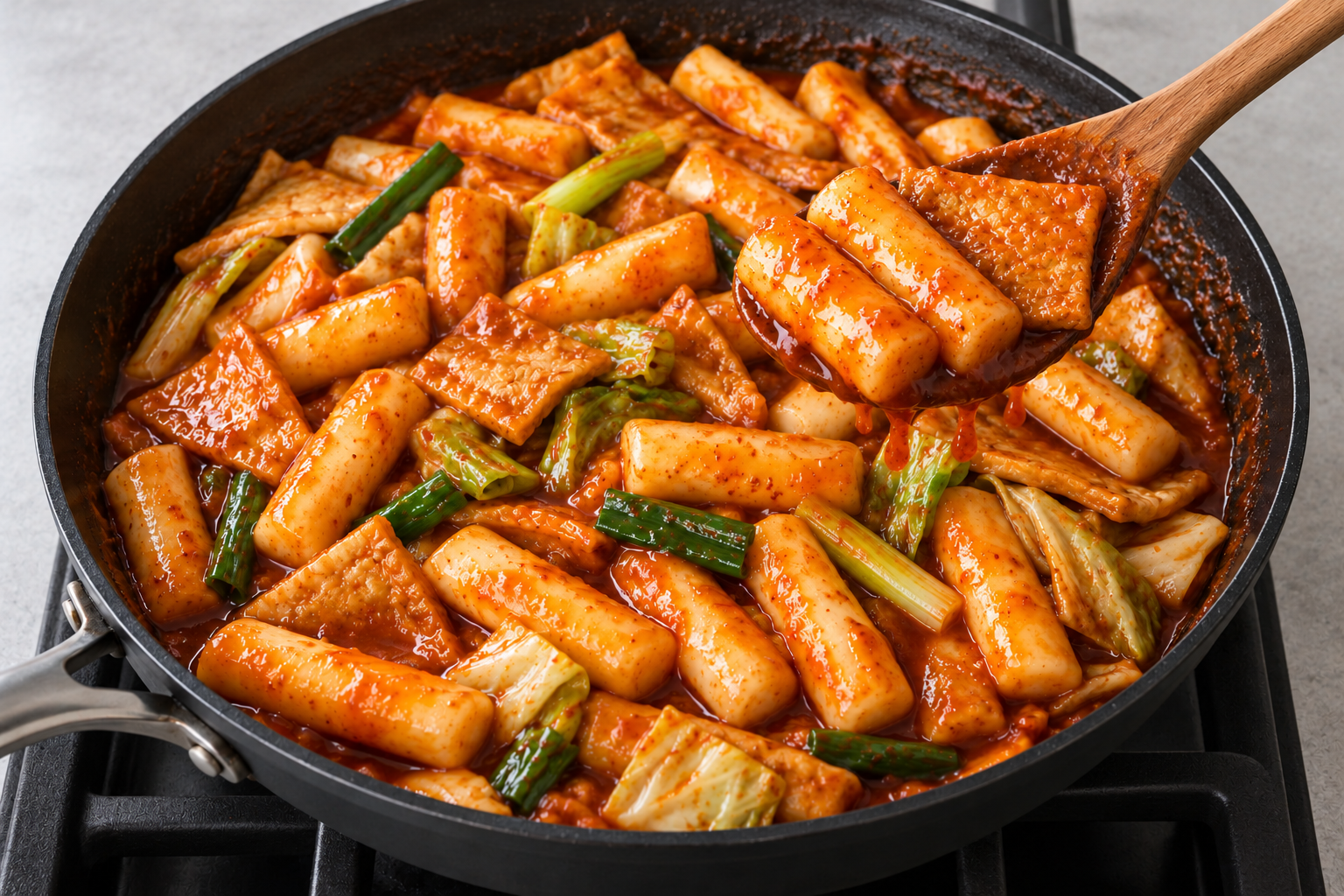
- Finish. Add fish cakes, cabbage, scallions and garlic. Continue simmering and stirring until the cabbage softens, the fish cakes meet their package cooking directions, and the sauce clings to the rice cakes. Add water if needed to keep it saucy. Serve promptly.
Shopping and substitutions
Look for plain tteokbokki tteok, Korean gochujang and thin eomuk fish-cake sheets in a Korean grocery or an Asian grocery’s Korean section; local stock has not been checked. Gochujang is a fermented chili paste, not interchangeable with sriracha or ordinary hot sauce. Water is an author-supported alternative to anchovy broth, with a lighter savory flavor. Omitting gochugaru reduces heat but does not make gochujang mild.
Allergens: anchovy broth and fish cakes contain fish. Gochujang, soy sauce and fish cakes may contain wheat or soy; fish-cake formulas may also include egg or shellfish. Read every label and cross-contact statement. Rice-based cakes do not make the whole dish gluten-free. For a meatless variation, omit fish cakes and use water or vegetable broth, checking all remaining ingredient labels; that variation has not been tested here.
Storage and safety limits
Chill shallow portions within 2 hours (1 hour above 90°F/32°C); refrigerate at or below 40°F/4°C. Handling limits. Use within 1–2 days for quality. Quality-storage reference. Reheat throughout to 165°F/74°C. Temperature reference.
Read the shared kitchen-safety guide before cooking; the recipe-specific limits above still apply.
Sources and scope
- Hyosun, Korean Bapsang: ingredient framework, staged cooking and water/vegetable-broth options.
- Maangchi: softness, sauce consistency and product-dependent rice-cake preparation.
- Sue Pressey, My Korean Kitchen: fish-cake quantity, rice-cake preparation and short quality-storage window.
- FDA: food-allergen labels.
Sources checked October 26, 2026 (UTC). This adaptation combines documented techniques and uses its own wording. No hands-on cooking test or nutrition analysis has been performed. AI illustrations are stage examples, not measurements of ingredients or proof of a tested result.
QUESTIONS & EXPERIENCES
Comments 0
Share a question or experience about this guide, then keep the conversation going with replies.
No published comments yet. Be the first to share a question or experience.